Workflow & Business Automation
The work that happens whether anyone remembers or not.
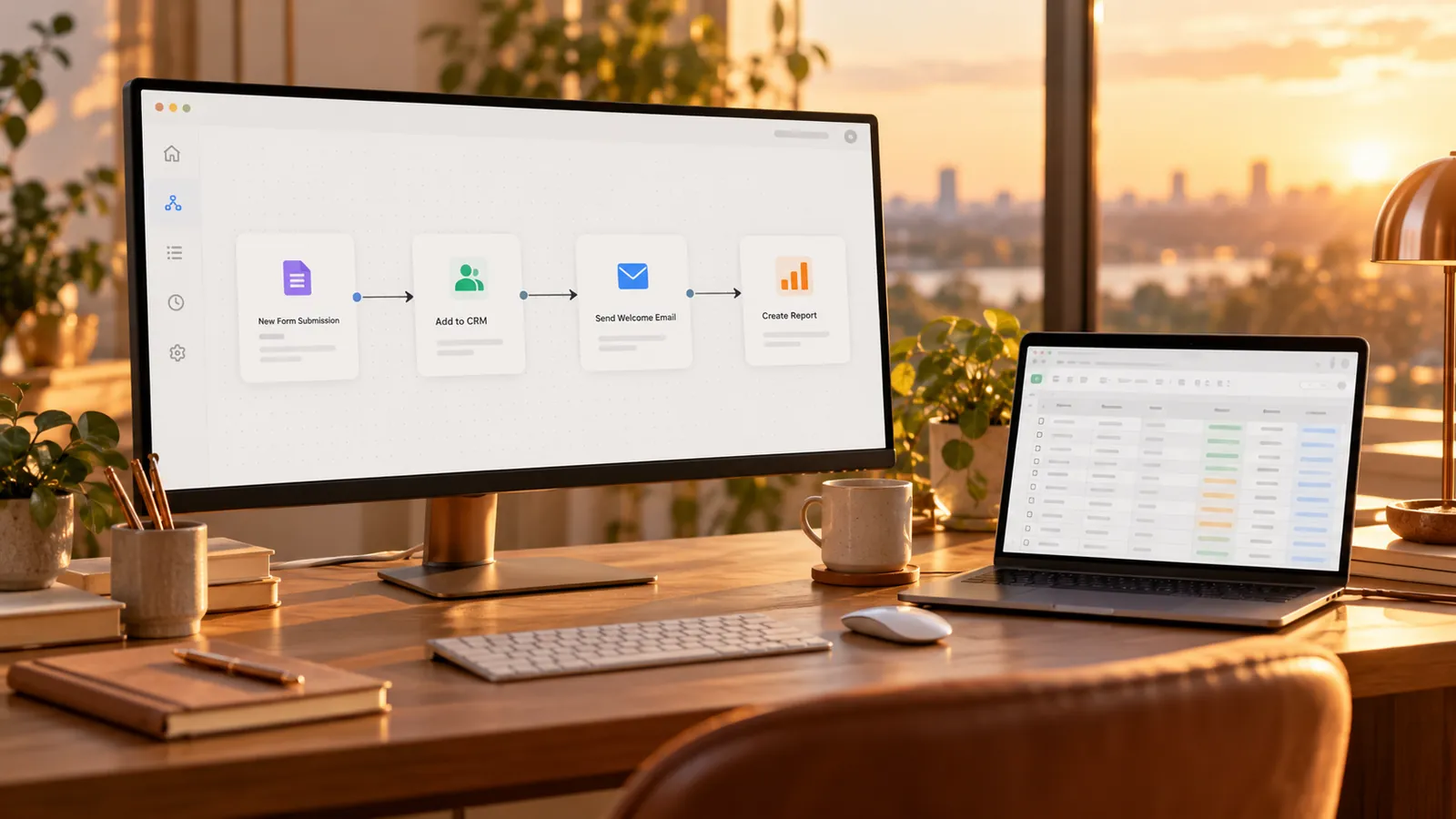
Lead capture into CRM into follow-up, invoice chasing, report generation and the spreadsheet somebody updates by hand every Friday - wired together so they run themselves.
Migrations, logging and tests written first, not last
How we think about it
Most businesses do not need more software; they need the software they already pay for to talk to itself. We map the process first - every step, including the manual ones people do not mention - and automate the parts that are genuinely repeatable. The parts that need judgement stay with a person, clearly marked.
Automation is where the other services compound: the chatbot writes into the CRM, the CRM triggers the WhatsApp sequence, and the dashboard reports on all of it.
What this covers
The work, specifically.
- 01
Lead to CRM to follow-up
An enquiry reaches the CRM, gets assigned and gets a first reply without manual copying.
- 02
n8n, Make and Zapier
Built on the platform that fits your budget and who has to maintain it after handover.
- 03
Invoice and payment reminders
The chase that improves cash flow and that nobody enjoys doing.
- 04
Email and WhatsApp sequences
Drip campaigns that stop when someone replies, because that is the point.
- 05
Report generation
The weekly report assembled and sent before the meeting, not during it.
- 06
Sheets and Excel automation
The spreadsheet that runs half your business, made reliable.
- 07
Multi-agent workflows
Several AI steps chained for a whole process, with checkpoints a human can inspect.
Need Workflow & Business Automation for something specific?
Tell us what you're trying to ship and we'll say plainly whether this is the right service for it — including when the answer is no.
How it runs
The same four steps, whatever we're building.
No account-manager relay. The lead on your project is someone who builds, and they stay on it from the first call to the last deploy.
Scope
A week of hard questions. We map what you actually need and say plainly which parts we'd cut.
Prototype
Something real in front of you early, not a document about it. Opinions get cheaper.
Build
Two-week cycles, a demo at the end of each. You see progress, not status reports.
Hand over
Documentation, a walkthrough, and the keys. Support if you want it — never as a hostage.
Questions
The things people ask before they enquire.
It depends on scope, but we will give you a number before you commit to anything. Most engagements start with a paid discovery — a fixed fee, a week or two — which ends in a written scope and a real budget. If the budget does not work, you leave with the scope document and no obligation to continue.
A typical first ship is around six weeks. Larger builds run in two-week cycles after that, each ending in a demo of something that actually runs. You will know within the first cycle whether the timeline is holding, rather than finding out near the deadline.
The people you meet. The lead on your project is someone who builds, and they stay on it from the first call to the last deploy. There is no account manager relaying messages between you and an unseen team.
You own everything — code, assets, accounts, domains. We hand over with documentation and a walkthrough, and your team can run it without calling us. If you would rather we stayed on for maintenance or a next phase, that is a separate agreement, not something buried in the original contract.
Yes. Most of our work is remote, and we keep a few hours of overlap with your working day for calls. Timezone has not been the hard part; unclear scope has.
Where it meets the others